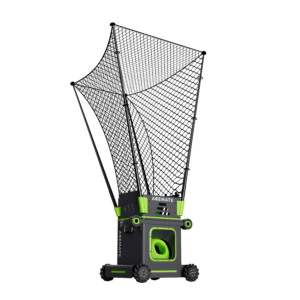
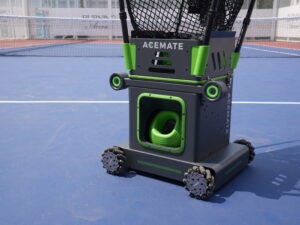
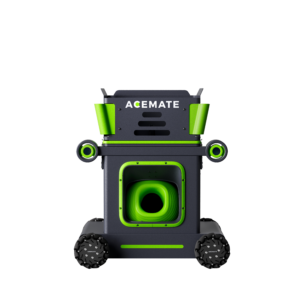
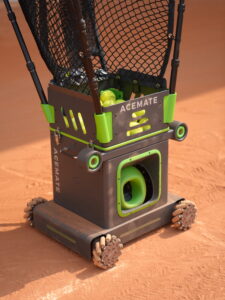
ACEMATE TEAM is using IFA 2026 in Berlin to officially unveil its new S10 Pro, the brand’s new flagship AI-powered tennis robot.
ACEMATE is not starting from scratch. The S10 Pro builds on the highly original concept introduced with the first ACEMATE S10: a mobile tennis robot capable of tracking the ball, moving around the court, and creating real rallies with the player.
---------------
👉 Discover the ACEMATE S10 Pro on the official ACEMATE website.
---------------
But this new Pro version goes much further.
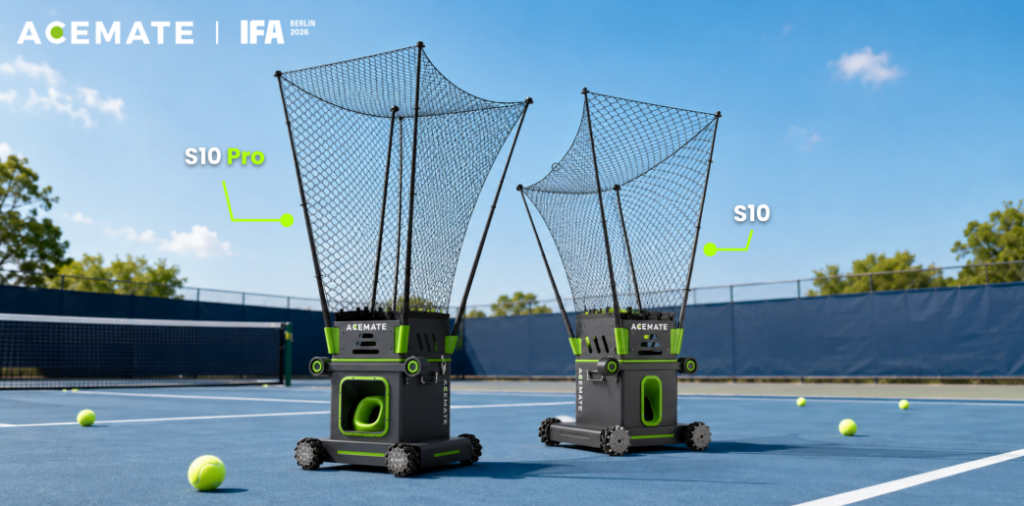
ACEMATE now introduces five core training modes, a completely new launching system called ACE+ SHOT™, ball speeds of up to 75 mph (120 km/h), stronger spin, horizontal shot coverage of up to 180°, a dedicated serve mode, a true AI opponent mode, up to four hours of battery life, and a much more complete AI-powered performance analysis system.
On paper, several of these upgrades directly address areas where we wanted to see improvements after our experience with the original S10.
So, let’s take a closer look at what the new ACEMATE S10 Pro promises to offer — and, more importantly, what we will want to check when we get the opportunity to properly test it on court.
The ACEMATE concept remains very different from a traditional tennis ball machine. A conventional ball machine generally stays in one position and feeds balls according to a predefined program.
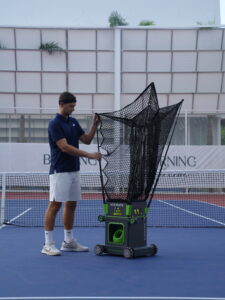
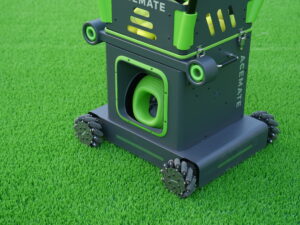
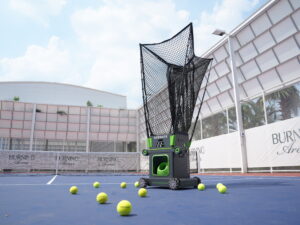
The S10 Pro, on the other hand, features dual 4K HDR binocular vision and an omnidirectional movement system. This allows it to track the trajectory of the ball and move around the court.
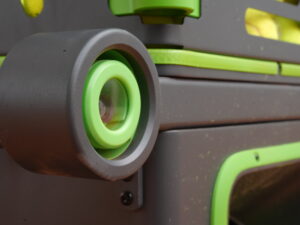
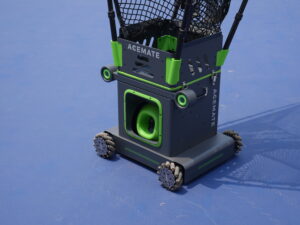
In Rally Mode, when a shot from the player lands in the court, the robot can move toward the bounce location, collect the ball and send it back.
The goal is no longer simply to receive a sequence of feeds, but to create an actual rally.
This was already what made the original S10 so unique. With the S10 Pro, ACEMATE now aims to turn that concept into a genuine tool for intensive and structured tennis training.
The S10 Pro is built around five core training modes, allowing players to progress from a simple warm-up to more match-like situations.
Rally Mode builds on ACEMATE’s signature concept.
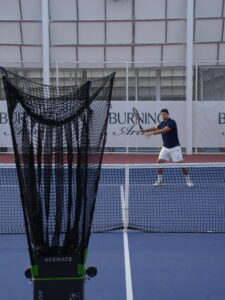

The player hits a ball. The robot detects its trajectory, moves into position, collects the ball and sends it back.
The idea is to establish a natural hitting rhythm and create continuous rallies without needing a practice partner.
This mode could be particularly useful for:
Of course, we will still need to see how much pace and intensity the S10 Pro can maintain during a real rally.
Drill Mode focuses more specifically on targeted practice.
The player is asked to hit designated areas of the court, while the system awards a score based on the results.
This is where the concept becomes especially interesting from a training perspective.
The player is no longer simply asked to return the ball: each shot has an objective and a target.
This mode could be used to work on:
ACEMATE also suggests using this mode to measure how a player’s shot accuracy improves through repetition.
Serve Mode is probably one of the features we are most interested in testing.
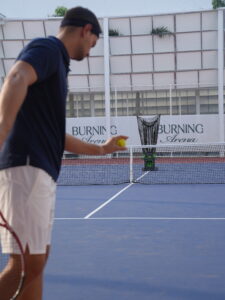
The S10 Pro is designed to analyze the player’s serve and track several parameters:
But ACEMATE goes one step further.
After the serve, the robot can simulate a return of serve, allowing the player to immediately play the next shot.
In other words, you can work on the classic serve +1 pattern.
This is a particularly interesting development.
The serve is still very often practiced in isolation, without really integrating what happens immediately afterwards.
In a match, however, the quality of the serve obviously matters, but so does the player’s ability to take advantage of the next ball.
If the S10 Pro can simulate this situation effectively, Serve Mode could become one of its most useful features for competitive training.
ACEMATE has not abandoned traditional ball-machine training.
Ball Machine Mode allows the S10 Pro to operate as a programmable tennis ball machine.
This is the mode that offers the widest range of adjustable shot parameters.
Players can create consistent and repeatable feeds to work precisely on a stroke or specific game situation.
This type of training remains essential for:
This is probably the most ambitious feature of the new S10 Pro.
In Battle Mode, the robot no longer simply follows a predefined sequence.
It analyzes the incoming ball and decides for itself how to respond, attempting to reproduce the shot patterns of a real tennis player.
Four preset playing styles are available:
The robot should therefore behave differently depending on the selected playing style. The mode also records the score and point-by-point results, allowing the player to assess performance in a more match-like environment.
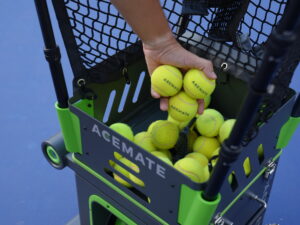
On paper, this is obviously very appealing. But it is also one of the modes we will want to test most carefully. This is probably where the S10 Pro’s artificial intelligence will really need to prove its value.
One of the S10 Pro’s biggest changes is found inside the ball-launching system itself.
ACEMATE introduces a new technology called ACE+ SHOT™ Tech.
With many ball machines, making a major change in shot direction requires the machine itself — or its launching mechanism — to rotate.
The S10 Pro can now change the horizontal shot direction inside the machine itself.
The robot therefore does not need to completely change its orientation before every feed.
According to ACEMATE, this should allow:
The announced horizontal coverage is now up to 180 degrees.
This could be a significant upgrade when building drills that require the player to cover large areas of the court.
Another major upgrade is speed.
ACEMATE now claims a maximum ball speed of 75 mph (120 km/h).
This is something we will be watching particularly closely. From our experience with the original S10, ball speed — and especially its ability to produce genuinely fast, penetrating shots — was one of the areas where we wanted to see an improvement.
The new 75 mph (120 km/h) maximum therefore appears to be a significant step in the right direction.
The S10 Pro allows players to adjust several parameters:
ACEMATE also claims stronger spin and more precise ball placement.
This should make it possible to create a wide variety of situations:
Once again, the specifications look promising.
But what we will really want to evaluate is the actual quality of the spin.
Simply changing the trajectory is not enough to reproduce a genuinely heavy topspin or sliced ball. What will particularly interest us is how the ball behaves after the bounce.
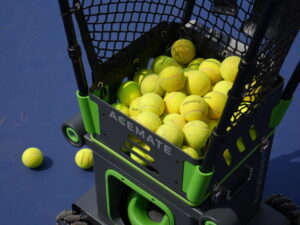
The S10 Pro can hold up to 100 tennis balls.
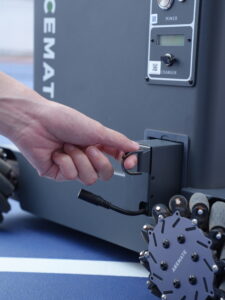
ACEMATE now claims up to 5 hours of battery life, compared with around two hours for the original S10.
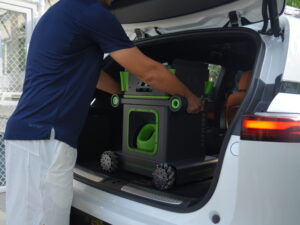
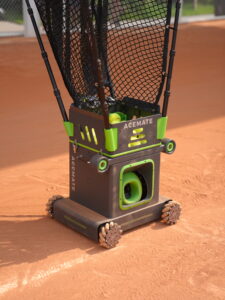
The robot is also designed to operate on:
Four hours of battery life is obviously an important improvement for intensive use.
For an individual player, that is very comfortable. For a coach, academy or tennis program, it becomes even more valuable.
We will also be interested to see how the movement system performs on clay, which is naturally a more demanding surface for a mobile robot.
The ACEMATE app is expected to include more than 100 built-in training plans.
Depending on the selected mode, players can choose an existing session or customize their own parameters.
The S10 Pro can be controlled using:
Gesture control is particularly interesting for this type of product.
When training alone, constantly walking back to your phone to start, stop or modify a drill can quickly become frustrating.
Anything that allows the player to stay on court and focused on training is therefore a welcome addition.
ACEMATE now structures its training system around five stages:
Train – Track – Analyze – Review – Improve
During compatible modes, the robot collects performance data throughout the session.
After training, the app is designed to provide:
This is probably one of the areas with the greatest potential.
But it is also one of the features we will approach most cautiously until we have actually tested it.
Collecting a large amount of data is relatively easy.
Turning that data into genuinely useful recommendations that can help a tennis player improve is much more difficult.
For us, the real value of this feature will therefore depend much more on the quality of the analysis than on the sheer number of statistics displayed.
The announced MSRP in the United States is:
ACEMATE has announced the following regional MSRPs:
ACEMATE is now accepting deposits for S10 Pro preorders.
This is clearly a premium product.
On paper, the ACEMATE S10 Pro looks extremely promising. The original S10 had already introduced something genuinely different to the market: a mobile robot capable of collecting the player’s ball and creating a rally.
The S10 Pro now appears ready to take the concept to the next level. ACEMATE wants to turn it into a true training partner capable of simulating match situations.
Several upgrades stand out to us in particular:
And we are really looking forward to finding out what it can actually do on court.